ACOPPHE

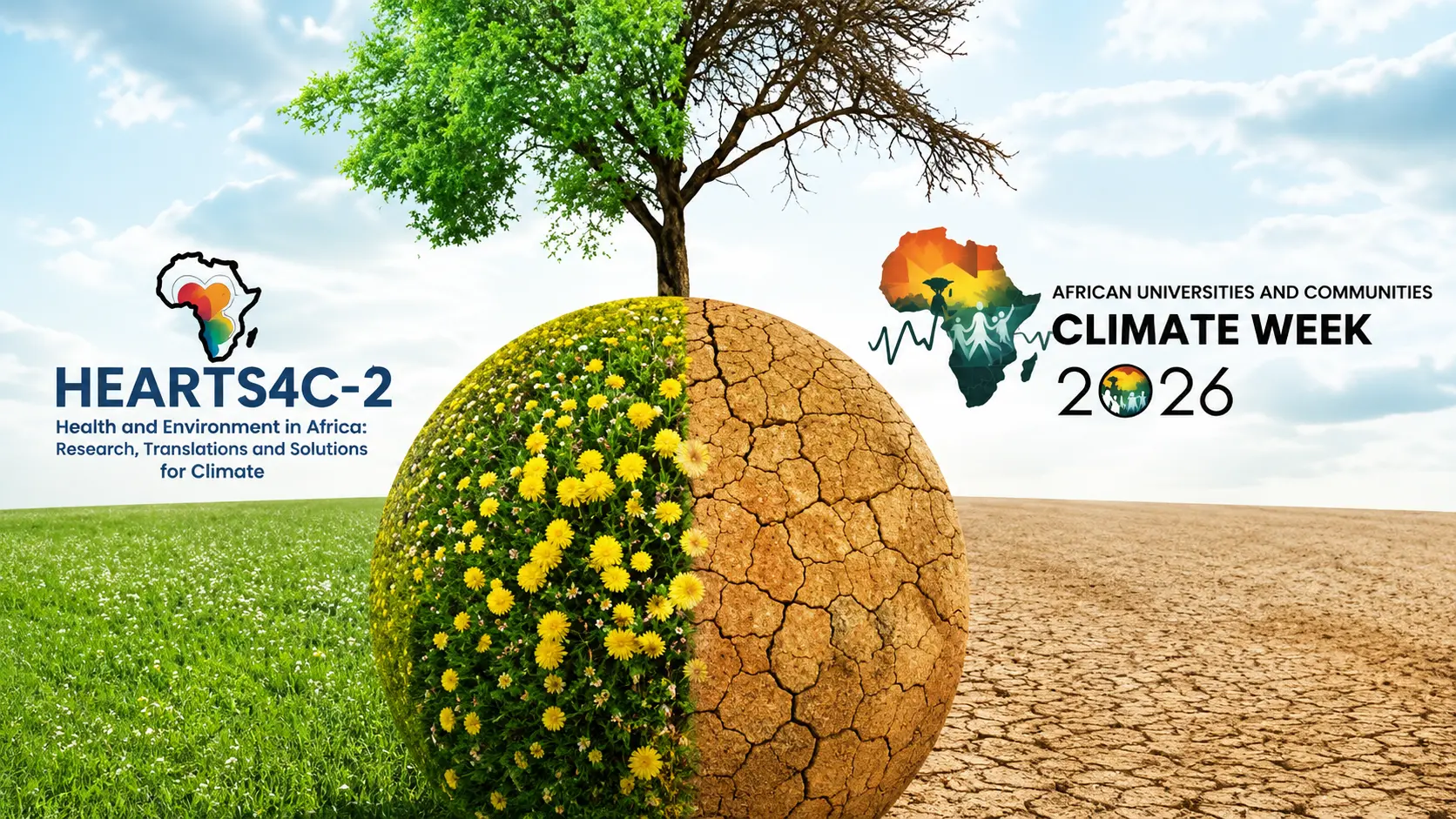
THE 2ND HEALTH AND ENVIRONMENT IN AFRICA: RESEARCH, TRANSLATIONS AND SOLUTIONS FOR CLIMATE (HEARTS4C-2)
A TRANSDISCIPLINARY AND TRANSLATIONAL INTERNATIONAL CONFERENCE

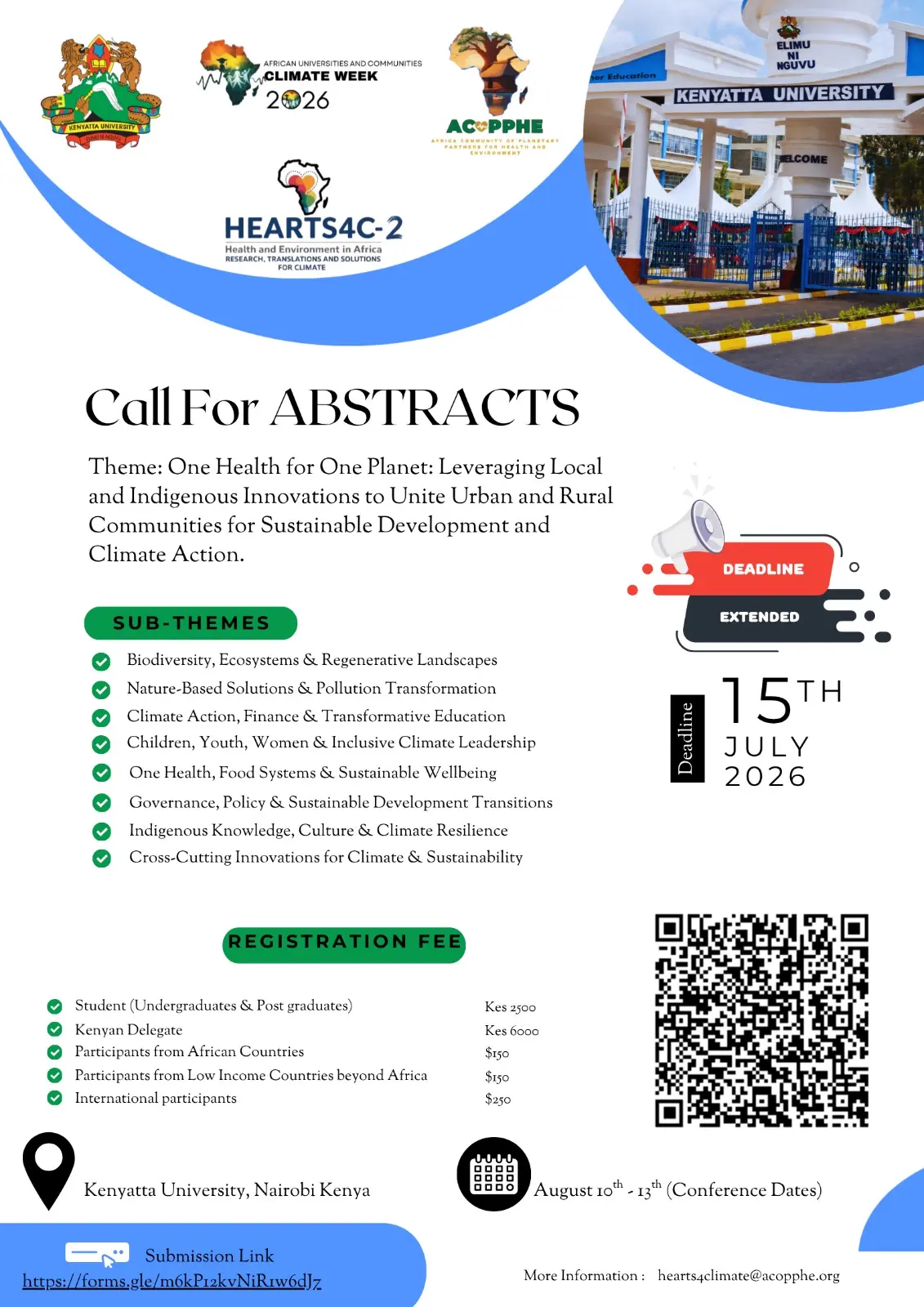
The theme of the Conference is:  One Health for One Planet: Leveraging Local and Indigenous Innovations to Unite Urban and Rural Communities for Sustainable Development and Climate Action, and will be anchored on the following sub-themes;
 KENYATTA UNIVERISTY
 10TH – 13TH, AUGUST 2026

Background

Kenyatta University (KU) and The Africa Community of Planetary Partners for Health and Environment (ACOPPHE) will co-organize the Translational Research Conference titled "The 2nd HEARTS 4 Climate: Health and Environment in Africa–>Research Translations and Solutions for Climate Action and Resiliency." The conference is aimed at identifying and bridging the gap between research findings and practical solutions in the realms of health, environment and climate action across Africa. The conference is planned to be hosted in close proximity to the most impacted communities in rural-urban areas in Kenyatta University. This conference centers on the belief that communities who are most impacted by climate change and environmental degradation need to be meaningfully involved and appropriately centered within relevant research, discussions, actions, policymaking, planning and responses. The conference will be conducted in a rotatory manner between different countries in Africa and hosted in alternating institutions based on their rural-urban locations. The inaugural HEARTS4Climate Conference was held at the Maasai Mara University, Kenya on August, 2025. This will be the second version of the conference and it will be held at the Kenyatta University, Nairobi Kenya between 10th – 13th August.


Objectives:

  •   I. Showcase Innovative African research
  •   II. Advance opportunities and solutions
  •   III. Promote Community centered approach
  •   IV. Assess current levels, scope and typologies of participants’ engagement in policy, practice and research
  •   V. Underscore the critical importance of increasing the enrolment of the youth in community health- and climate action-related programs as a pathway for responding to outbreaks, preparing for and responding to environmental changes and reducing youth unemployment.

Scope of Participants

The Conference will engage: Academicians, Students and Researchers, Policymakers and Practitioners, NGO and CBO Leaders, Government and UN Officials, Traditional Healers and Indigenous Leaders, Members of communities that are disproportionately Impacted by climate change and other related issues including:Youth and Digital Health Innovators, Health Professionals and Environmental and Climate Advocates.

The anticipated in-person scientific attendance will range from 100 - 150 participants, ensuring a diverse and impactful audience.
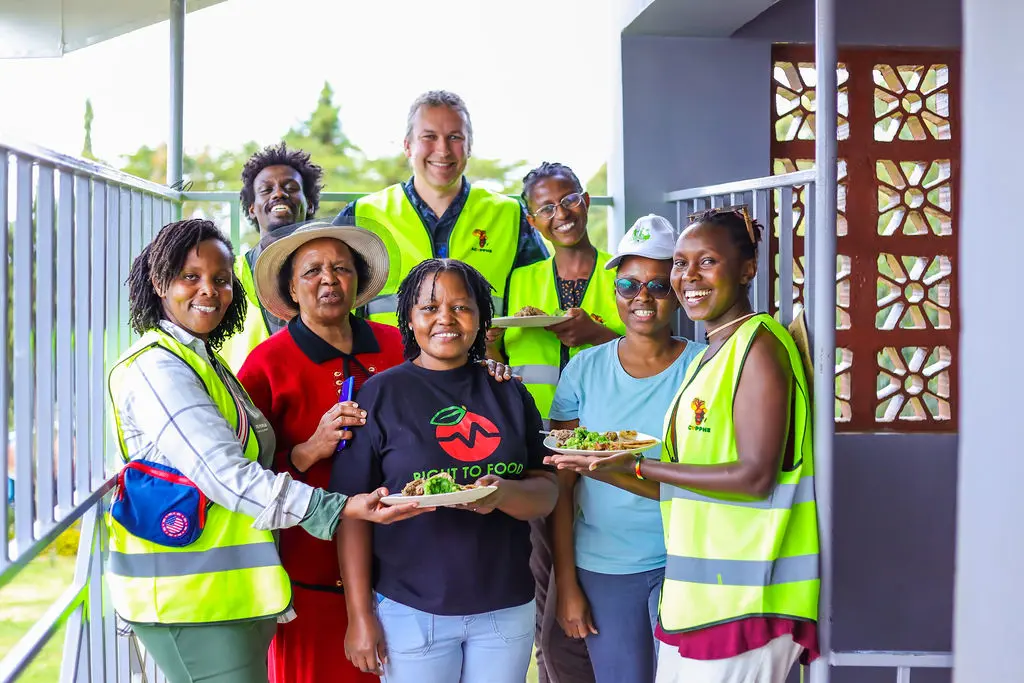
Kenyatta University Venue & Participants Landscape

Conference Sub-Themes

1. Biodiversity, Ecosystems & Regenerative Landscapes

Innovations at the nexus of wildlife, plant systems, soil health, and ecosystem restoration

Sub-themes:
  • Biodiversity conservation and restoration ecology
  • Wildlife–livestock–human interactions
  • Soil health, carbon sequestration, and regenerative agriculture
  • Agroforestry and climate-smart landscapes
  • Ecosystem services valuation and natural capital accounting
  • Land degradation, desertification, and restoration pathways
  • Landscape ecology and spatial planning tools

2. Nature-Based Solutions & Pollution Transformation

Harnessing conservation and circular approaches to combat pollution

Sub-themes:
  • Nature-based solutions (NbS) for ecological restoration, climate mitigation and adaptation
  • Air, water, and soil pollution management
  • Plastic pollution and microplastics research
  • Circular economy and waste-to-resource innovations
  • Urban green infrastructure and pollution control
  • Industrial ecology and cleaner production systems
  • Ecosystem-based approaches to pollution remediation

3. Climate Action, Finance & Transformative Education

Advancing finance, policy, and knowledge systems for climate resilience

Sub-themes:
  • Climate finance, carbon markets, and green investment models
  • Loss and damage financing mechanisms
  • Climate change education and curriculum innovation
  • Climate risk modeling and decision-support systems
  • Mitigation and adaptation strategies across sectors
  • Private sector engagement and green entrepreneurship
  • Monitoring, reporting, and verification (MRV) systems

4. Children, Youth, Women & Inclusive Climate Leadership

Empowering underrepresented groups as agents of positive change and solutions to the Triple Planetary Crisis.

Sub-themes:
  • Gender and climate change
  • Youth innovation, entrepreneurship, and activism
  • Climate justice and equity frameworks
  • Social inclusion and vulnerable populations
  • Capacity building and leadership development
  • Community-led climate solutions
  • Education and behavioral change for sustainability
  • Environmental Clubs and school-led opportunities for student engagement

5. One Health, Food Systems & Sustainable Wellbeing

Integrating human, animal, and environmental health systems

Sub-themes:
  • One Health, climate and health and planetary health frameworks
  • Sustainable agriculture and food systems transformation
  • Water, sanitation, and hygiene (WASH)
  • Climate-sensitive diseases and environmental health risks
  • Nutrition security and food resilience
  • Renewable energy for health and rural systems
  • Universal Health Coverage (UHC) and climate resilience

6. Governance, Policy & Sustainable Development Transitions

Enabling systems change through institutions and policy

Sub-themes:
  • Environmental governance and institutional frameworks
  • Climate policy and international agreements
  • Decentralization and community-based governance
  • Policy coherence across sectors (water, energy, land)
  • Sustainable development planning and SDG integration
  • Environmental law, compliance, and enforcement
  • Public participation, advocacy, and accountability

7. Indigenous Knowledge, Culture & Climate Resilience

Leveraging biocultural systems for sustainability

Sub-themes:
  • Traditional ecological knowledge (TEK) and Indigenous knowledge systems (IKS)
  • Cultural heritage and environmental stewardship
  • Indigenous climate adaptation strategies
  • Language, knowledge transmission, and sustainability
  • Ethnobotany and herbal medicine
  • Sacred landscapes and conservation ethics
  • Co-production of knowledge (science–community partnerships)

8. Cross-Cutting Innovations for Climate & Sustainability

Emerging tools, ideas, and interdisciplinary approaches

Sub-themes:
  • Artificial intelligence, big data, and climate informatics
  • GIS, remote sensing, and spatial analytics
  • Climate-tech and digital innovation
  • Sustainable business models and green economies
  • Human rights, rights of nature, and environmental justice
  • Arts, storytelling, and climate communication
  • Ocean, marine, and blue economy systems
  • Social movements and behavioral transformation

Abstract Template

Abstracts with a maximum of 300 words should be provided in Ms Word or Latex files. Your Abstract should be structured as follows (without numbering);

  • Sub-theme applying to
  • 1. Title
  • 2. Name
  • 3. Affiliation
  • 4. Email
  • 5. Telephone contact
Abstract body (300 words max) structured as follows;

An introductory title, brief summary of challenge being tackled, main motivation of study, methods used, primary findings and resolutions of the study relevant in combatting global challenges. Kindly remember to mention the sub-theme, national and global blueprints being addressed before your abstract. Figures and citations are greatly discouraged in the abstracts.

Please save your files as: Subtheme number _ Country _ Institution _ Your Name

An acknowledgement email will be given within 24 hours of registration and the reviewed abstracts will be sent back to you by date. The applicants will then be expected to work on the given corrections/suggestions and revert back by date alongside their full papers, projects, posters and innovations. The formats and guidelines of the papers, projects, posters and innovations will be communicated while sending back your abstracts.

Abstract Submissions

Submit your application using the form below by 15th July, 2026.

Abstracts will be reviewed on a rolling basis and the participants notified at least 2 weeks after submission. Participants who wish to attend without presenting are also welcome. Group presentations will also be allowed. The following registration fees will apply;

Category Early Bird Late Bird
Kenyan students (Undergraduates, Postgraduates) Ksh. 2,000 Ksh. 2,500
Kenyan academic staff/Kenyan Delegates Ksh. 4000 Ksh. 6000
East African participants $ 100 $ 150
African participants $ 100 $ 150
Participants in Low Income Countries beyond Africa $ 100 $ 150
Participants in Middle- and High-Income countries across the globe $ 200 $ 250

*The registration fees beyond 15th July, 2026 will be considered as late bird payments.

The charges cover:

all the presentations, stationery, all daytime meals, transport to and from their hotels to the conference venue, transport to the various conference related sites, a conference branded T-shirt, and bag.

All participants will receive a presentation/attendance certificate after the conference. While the abstracts will be published as conference proceedings, we pursue opportunities of the conference outputs to be published in relevant refereed journals or patented with national and global intellectual property bodies.

2nd HEARTS4Climate International Conference, 2026 — Kenyatta University, Kenya, 10–13 August 2026

Conference Application Form

1 Personal Information
2 Professional Information
3 Presentation Information
4 Supporting Documents
JPG, PNG, WEBP — Maximum 10 MB.

Save your file as: SubthemeNumber_Country_Institution_YourName

Abstracts with a maximum of 300 words should be provided in MS Word, DOCX or LaTeX files. Written in Times New Roman, Font 12, spacing 1.5. Title font should be 14 and bolded. Keywords should be 4–5 words separated by semicolons.

Your Abstract should be structured as follows (without numbering):

  1. Sub-theme applying to
  2. Title
  3. Name
  4. Affiliation
  5. Email
  6. Telephone contact
  7. Abstract body (300 words max)
DOC, DOCX, PDF, TEX — Maximum 10 MB.
5 Participation Information
*Note: Some of the activities will incur participation fee.

Conference Deadlines

  • a) Call for Abstracts – 15th July, 2026
  • b) Abstracts Review – on a rolling basis up to 1st August, 2026
  • c) Abstracts Notification – on a rolling basis up to 1st August, 2026
  • d) Full papers submission – 15th July, 2026
  • e) Registration dateline – 31st July, 2026
  • f) Actual conference dates – Monday, 10th August to Thursday, 13th August, 2026

For more information

Please visit the websites www.ku.ac.ke, www.acopphe.org as well as get in touch via hearts4climate@acopphe.org

Download official conference documents and previous reports

Kenyatta University • Nairobi, Kenya • 10–13 August 2026
Direct Contacts:
Kenyatta University Venue & Participants Landscape
Talk to us
tujenge mabati
ACOPPHE Support
Typically replies within 1 hour